Sculptor
Version 2.1
|
The latest release of
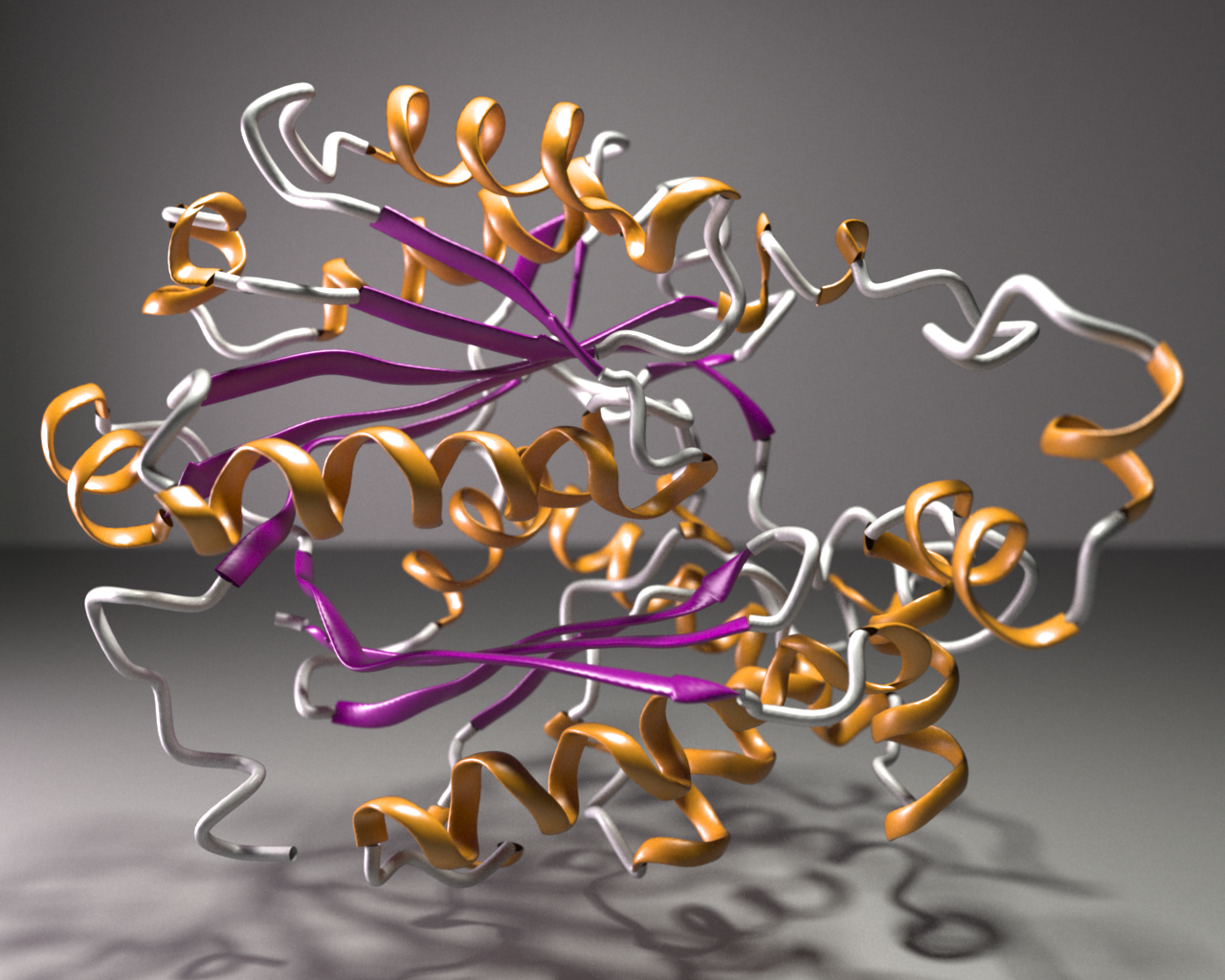
Sculptor includes multi-scale ambient occlusion illumination (Wahle and Wriggers, 2015) and the DPSV and VolTrac algorithms
for denoising and detecting filamentous densities (such as
alpha-helices and actin
filaments) in maps from EM and tomography (Starosolski
et al., 2012, Rusu
and Wriggers, 2012, Rusu
et al., 2012).
If
your OS is not supported:
|
|
The
previous major
release,
Sculptor Version 2.0, is available for download. A number of
new features
are introduced, including the following:
1. Multi-fragment
exhaustive search (using the MOSAEC
algorithm) and simultaneous off-lattice refinement (using
Sculptor's Refinement tool).
2. Scripting capabilities were added to Sculptor via the Lua
programming language.
3. Visualization is improved by supporting real-time ambient occlusion.
4. A new
PDF
user guide was created.
5.
Several
minor bugs in 1.2 were fixed. All functionalities of 1.2 (see below)
were retained.
Download Sculptor and PDF User
Guide
|
|
Sculptor
has been developed from at biomachina.org with
contributions from the following authors (in alphabetic order): Stefan
Birmanns, Maik Boltes, Paul Boyle, Jan Deiterding, Frank Delonge, Sayan
Ghosh, Jochen Heyd, Oliver
Passon, Mirabela Rusu, Francisco Serna, Zbigniew Starosolski, Manuel
Wahle, Willy
Wriggers, and Herwig Zilken.
|
|
Version 1.2
The
Sculptor 1.2 release supported
¨interactive global docking¨ peak search as a major new
feature,
but also
added programmable-GPU accelerated rendering of atomic models, other
smaller improvements and bug fixes.
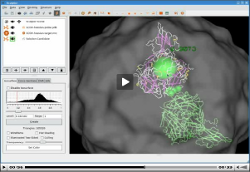
Interactive Global Docking (IGD) is a novel technique that
enables an
interactive peak search in translation function scoring landscapes
generated from exhaustive docking
tools like Situs / colores (Situs release 2.5
supports IGD).
In experimental volumetric maps with a heterogeneous density
distribution, or significant areas that are not accounted for by the
atomic model, multi-resolution docking can be problematic. The correct
solution may be difficult for the automatic algorithms to detect, as
the docking contrast - the numerical difference of scores of false and
true positive solutions - can become very small. An interactive
screening of the scoring landscape allows the user to select carefully
the potential solutions, which then can be further optimized using an
off-lattice refinement technique. Please click on the image below to
see a video with the interactive global docking in action:
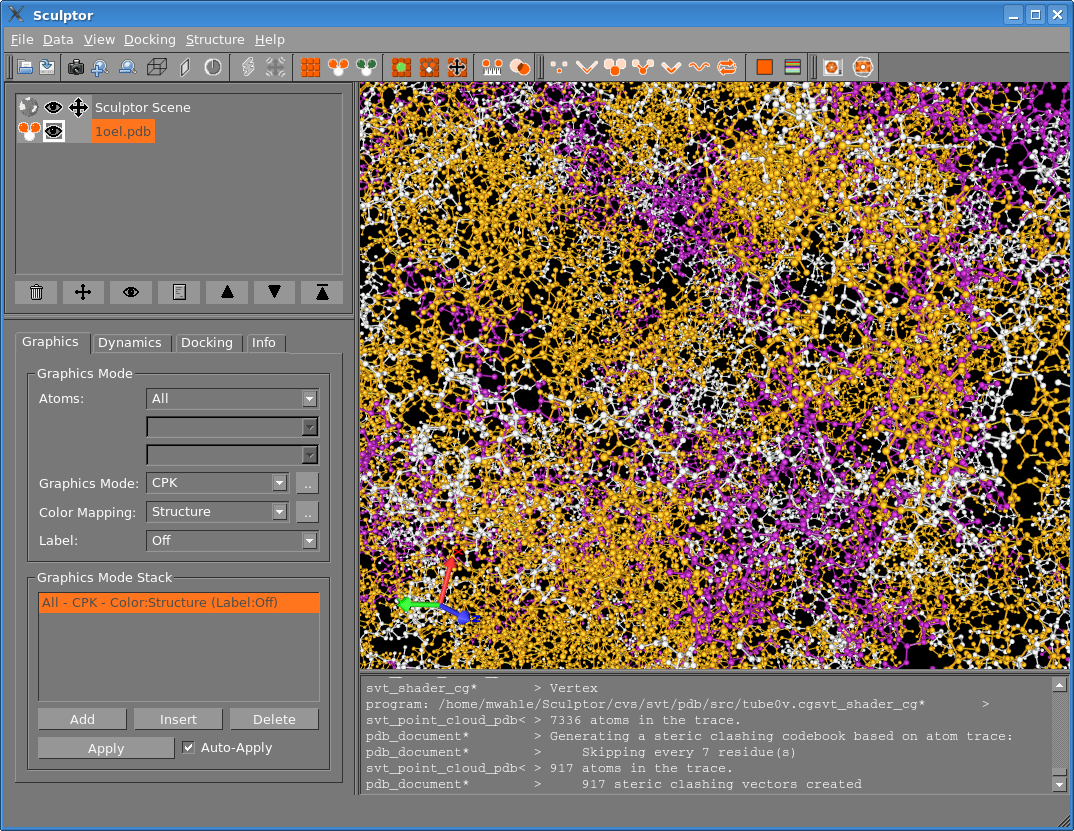
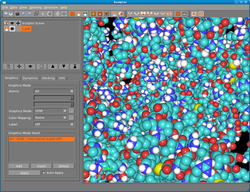
Programmable-GPU
accelerated rendering and
shading
of tube, cartoon and van-der-Waals representations. The new code is
optimized especially for low-end machines with inexpensive graphics
cards (for example netbooks with integrated Intel GMA950 graphics
chips, like the Asus EEE PC) and does not only lead to a higher-quality
representation, but at the same time also achieves a significantly
higher performance. Sculptor also enables the investigation
of pleiomorphic systems, especially in combination with the
efficient
flexible fitting technique which was introduced in Sculptor
1.1 / Situs
2.4.
Speed
improvements and code-cleanup in the
areas
of the cross-correlation coefficient calculation, loading and saving of
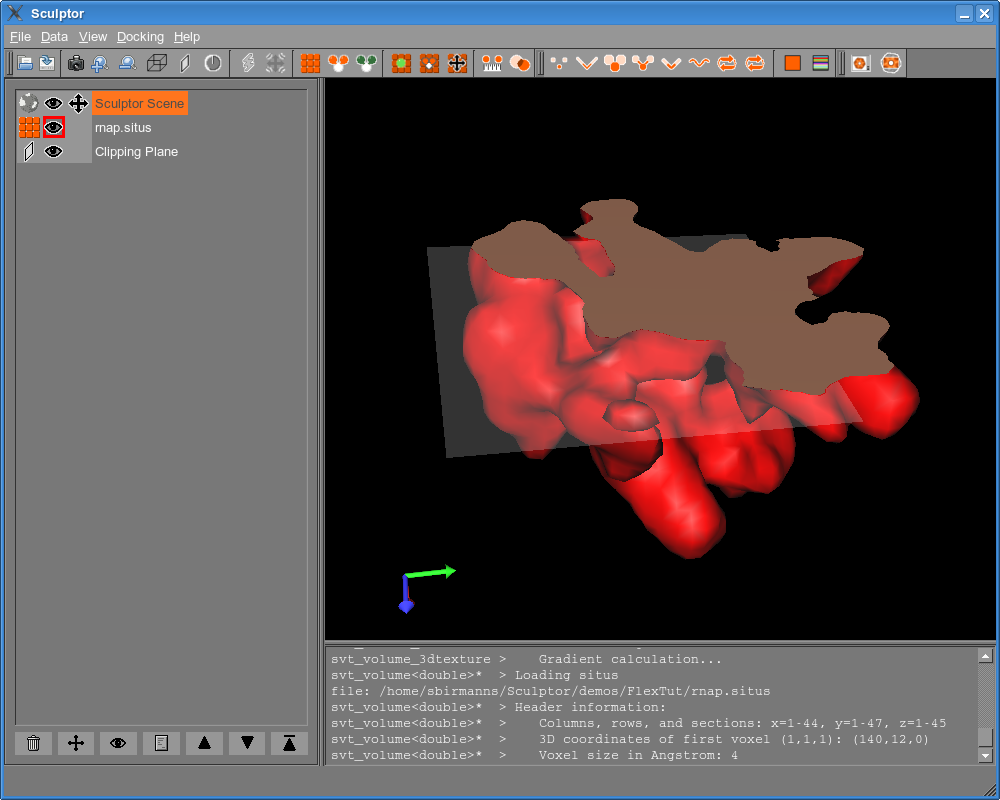
volumetric maps, display of the coordinate system and clipping planes.
Rendering under Microsoft Windows was improved.
Download
Sculptor and PDF User Guide
|
|
|
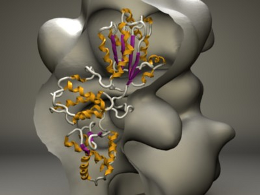 Sculptor
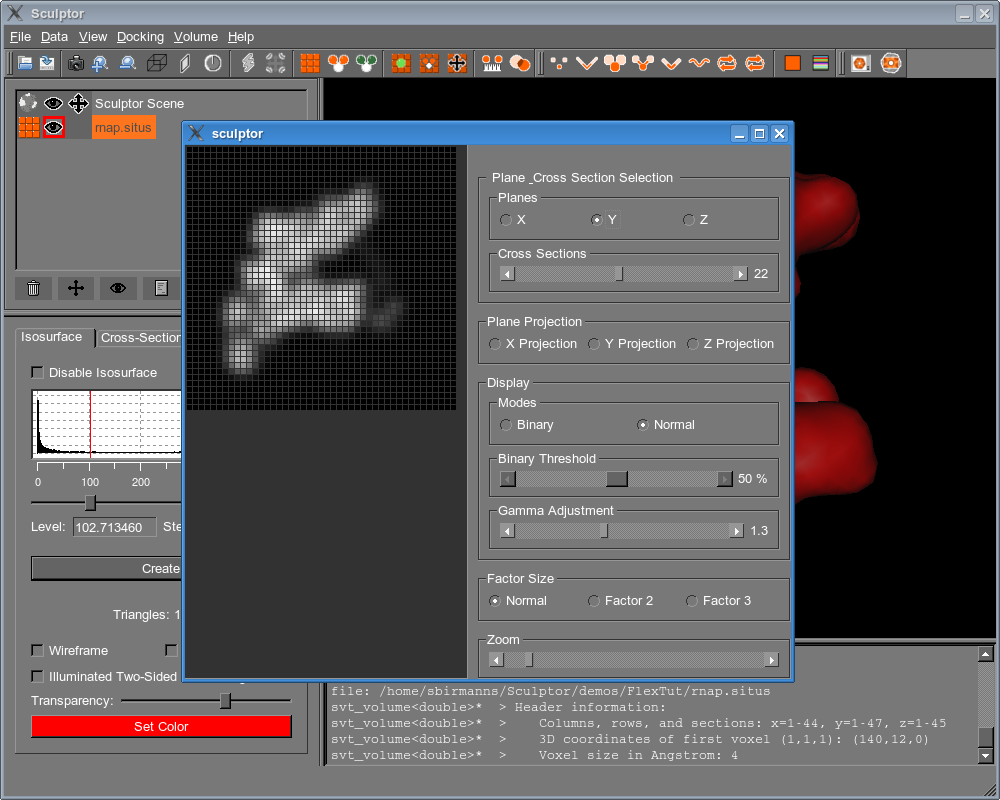
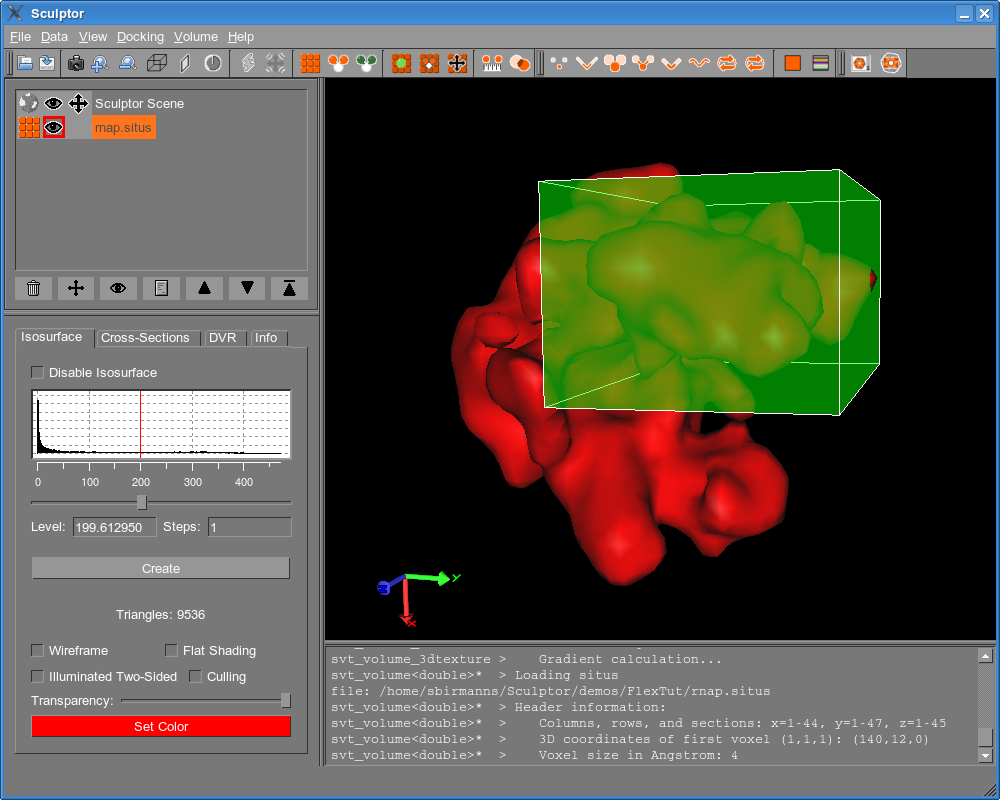
is an interactive multi-resolution docking and visualization program
for low-resolution density maps and atomic structures. We are
developing Sculptor as a GUI-based extension of the Situs docking
programs, to allow an interactive exploration and analysis of
volumetric maps. Sculptor combines 3D rendering with advanced
mathematical concepts like clustering techniques and pattern matching
algorithms to permit an almost instantaneous fitting of the
high-resolution structures and to facilitate typical post-processing
work like map editing or resolution adjustment. Sculptor is an
Sculptor
is an interactive multi-resolution docking and visualization program
for low-resolution density maps and atomic structures. We are
developing Sculptor as a GUI-based extension of the Situs docking
programs, to allow an interactive exploration and analysis of
volumetric maps. Sculptor combines 3D rendering with advanced
mathematical concepts like clustering techniques and pattern matching
algorithms to permit an almost instantaneous fitting of the
high-resolution structures and to facilitate typical post-processing
work like map editing or resolution adjustment. Sculptor is an